

RAG vs. Fine-Tuning: How to Actually Choose
Teams building an LLM-powered product often treat retrieval-augmented generation (RAG) and fine-tuning as interchangeable technical options. Enterprise adoption data shows that RAG is currently used more often than fine-tuning, but prevalence alone does not make it the right choice for every use case. The decision depends on what needs to change: the information available at inference time, the model's behavior, or both.
What Each Approach Actually Changes
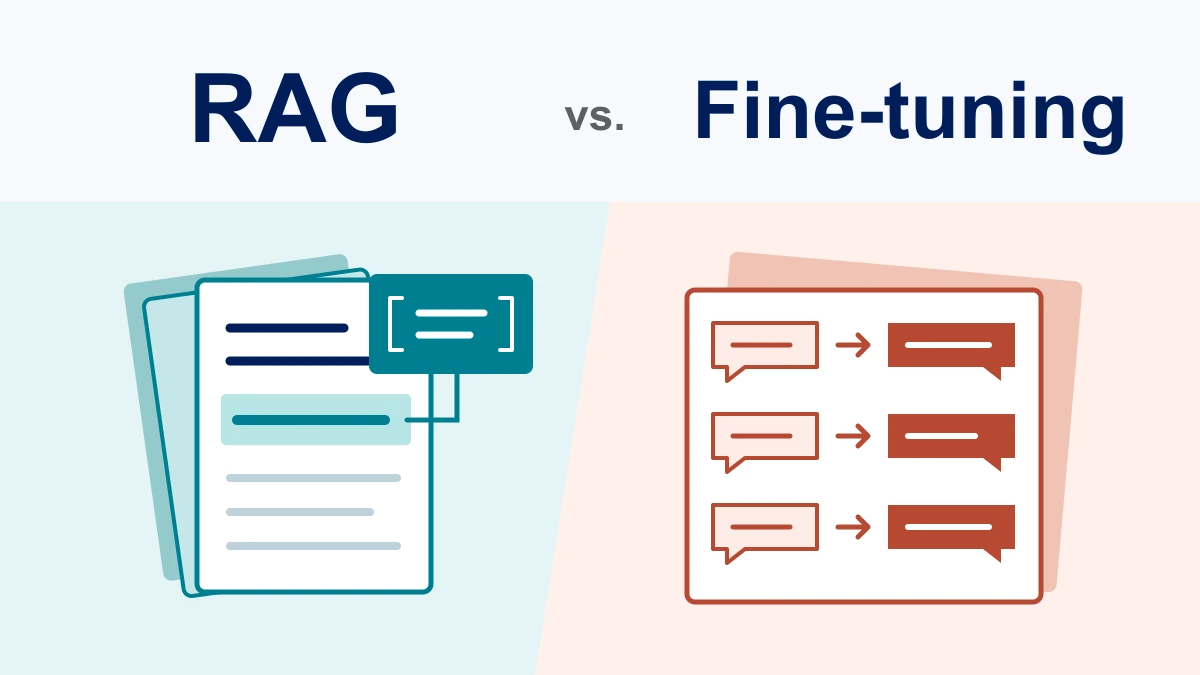
A typical RAG pipeline leaves the underlying model parameters unchanged and changes the context the model receives. At query time, the system retrieves relevant information from documents, databases, or other external sources and includes that evidence in the prompt before the model generates a response.
Supervised fine-tuning takes a different approach: it updates model parameters using examples specific to a task, teaching the model to produce the desired behavior more consistently. In this article, "fine-tuning" primarily refers to supervised fine-tuning; continued pretraining and other adaptation methods have different trade-offs.
That distinction shapes almost everything else about the decision. Once source documents are re-ingested and the retrieval index is refreshed, RAG can incorporate updated information without retraining the model. How quickly that happens depends on the ingestion pipeline. Fine-tuning is generally poorly suited to frequently changing facts such as pricing, policies, or product catalogs because keeping facts encoded in model weights current requires another training cycle rather than simply updating the source.

What Enterprises Are Actually Choosing
Menlo Ventures' 2024 State of Generative AI in the Enterprise report surveyed 600 U.S. enterprise IT decision-makers and reported RAG at 51% adoption, up from 31% the year before. Fine-tuning was far less common, appearing in just 9% of production models.
The ordering persisted in Menlo's 2025 enterprise AI report, based on 495 U.S. enterprise AI decision-makers. Prompt design remained the dominant customization technique, followed by RAG, while more advanced approaches such as fine-tuning, tool calling, context engineering, and reinforcement learning remained niche and were used primarily by frontier teams. These surveys describe adoption patterns, not a universal performance ranking.

The Cost Question Is Not What Most Teams Assume
It is easy to assume RAG is the cheaper option because it skips a training run. A 2026 preprint from BMW Group, Technical University of Munich, and LMU Munich researchers tested that assumption on two closed automotive-industry datasets. The researchers evaluated answer quality and operational costs across RAG and fine-tuning approaches.
In those automotive QA scenarios, RAG-based configurations increased per-request cost because retrieval and longer inputs added overhead. Under the authors' extended Cost-of-Pass model, however, RAG produced the lowest expected total cost because its measured accuracy reduced the modeled need for human validation and intervention.
That result is scenario-specific. The study used synthetic QA pairs derived from two proprietary datasets, GPT-4o as an automated judge, and illustrative assumptions of $0.10 per validation and $1 per human-generated answer. Those assumptions make the comparison useful, but they do not establish that RAG is always the lowest-cost option.
The same preprint found that smaller open-weight models paired with RAG could achieve quality comparable to larger proprietary models on the domain-specific questions it tested. That makes open-weight models worth evaluating when teams compare hosting, privacy, latency, and inference economics, although results from two automotive datasets should not be treated as a guarantee for every use case.

When Fine-Tuning Actually Makes Sense
None of this means fine-tuning is never the right call. It tends to earn its cost when the target is stable model behavior rather than frequently changing facts: a narrow task, a strict output schema, consistent style, correcting instruction-following failures, or enabling a smaller and cheaper model to perform a specific task reliably.
RAG and fine-tuning can also be combined. Fine-tuning can shape behavior and output patterns, while RAG supplies current or external information. Whether that hybrid improves quality enough to justify its engineering and operating overhead must be demonstrated with representative evaluations.
A Simple Way to Decide
- Does the information change regularly? RAG is usually the better starting point.
- Do you need to show where an answer came from? RAG can support attribution when the system preserves document metadata and surfaces the retrieved evidence, but it does not guarantee citation accuracy by itself.
- Is the task narrow, high-volume, and stable? Fine-tuning is worth evaluating.
- Do you need a consistent voice or output format? Fine-tuning may help when prompting has not been reliable enough.
- Do you need both current facts and consistent behavior? A hybrid approach may fit, provided the added complexity is justified.
The decision should not be based on architecture alone. RAG is only as good as the retrieval pipeline behind it. Poor document preparation, weak retrieval, irrelevant results, or missing information can give the model poor context even when the underlying knowledge base is accurate.
What to Look For in a Development Partner
Do they justify the adaptation strategy with representative evaluations?
Enterprise adoption statistics are useful context, but the choice should be tested against examples that represent the real workload. A team should explain which failure mode each component addresses and compare prompt-only, RAG, fine-tuning, or a hybrid when each option is relevant.
Do they talk about total cost, not just per-query cost?
RAG adds document ingestion, embeddings, retrieval, and longer-context costs. Fine-tuning adds dataset preparation, training, evaluation, and sometimes dedicated hosting, but it can shorten prompts and reduce latency at scale. Human review and the business cost of incorrect answers belong in the comparison too.
Can they explain when a hybrid approach is worth the complexity?
Combining RAG and fine-tuning adds engineering and operating overhead. A partner should be able to say plainly whether the use case needs that complexity or whether one approach gets you there.
Do they ask how often the underlying data changes?
This is one of the clearest signals of which approach fits. A team that skips the question is skipping an input that should drive the decision.
Moving From "Which Is Better" to "Which Fits Your Data"
RAG and fine-tuning solve different problems. Enterprise surveys show that RAG is currently more common for knowledge-grounded applications, and the cited industrial QA study found it effective in its specific scenarios. Neither source establishes a universal winner. Building LLM applications around how your data actually behaves, rather than defaulting to whichever approach sounds more technically impressive, gives a generative AI project a better chance of remaining accurate and economically sensible in production.
Frequently Asked Questions
Is RAG always cheaper than fine-tuning?
No. In the cited automotive QA study, RAG cost more per request than simpler configurations but produced the lowest modeled total cost under the authors' assumptions about validation, retries, and human fallback. Another workload can produce a different result depending on model choice, retrieval design, traffic, hosting, latency, and labor costs.
Can RAG and fine-tuning be used together?
Yes. Retrieval can supply current or external evidence while fine-tuning shapes task behavior or output format. A hybrid should be kept only when representative evaluations show that its gains justify the additional complexity.
Why is fine-tuning less common than the hype suggests?
Menlo's enterprise survey data reports fine-tuning in a small minority of production deployments compared with RAG, although adoption does not measure effectiveness for every task. Fine-tuning requires a representative dataset, training, and evaluation, and changing learned behavior generally requires another tuning cycle. RAG has different ingestion, indexing, and retrieval costs and can support, but not guarantee, source attribution.
Does RAG eliminate hallucinations?
No. RAG can improve factual grounding when retrieval returns relevant evidence, but it does not guarantee accuracy. It can still fail when retrieval misses the right source, returns stale or conflicting context, or the model ignores or misuses the evidence. Document preparation, retrieval, ranking, citation validation, and evaluation still determine how reliable the final answer is.
How do I know if my use case needs fine-tuning?
Fine-tuning is worth considering when a smaller model must perform a narrow task consistently, or when a strict tone or output format has not been reliable through prompting. Compare it against a prompt-only baseline and, for knowledge-intensive tasks, a RAG baseline using representative examples from the real workload.
Are open-weight models a viable alternative to proprietary models?
They can be. The 2026 industrial QA preprint found that smaller open-weight models paired with RAG could achieve quality comparable to larger proprietary models on the two datasets tested. The right choice still depends on the task, data, evaluation results, security constraints, hosting model, and operating requirements.
Ready to Build an LLM System That Fits Your Actual Data?
The right architecture depends on how your data behaves, not on which approach is getting the most attention this year.
If you are deciding between RAG, fine-tuning, or a hybrid approach, we can help determine which one fits the problem and how to test it responsibly.