Custom AI vs.Off-the-Shelf AI:When Does Building Make Sense?

The short answer
Buy
Choose an existing AI product when it meets your requirements at an acceptable total cost.
Build
Test a focused custom component when an important gap remains and the additional value justifies the investment.
Combine
Keep the product for established workflows. Add a custom component for the requirement it cannot meet.
01 / Define the problem
One manufacturer.
One forecasting problem.
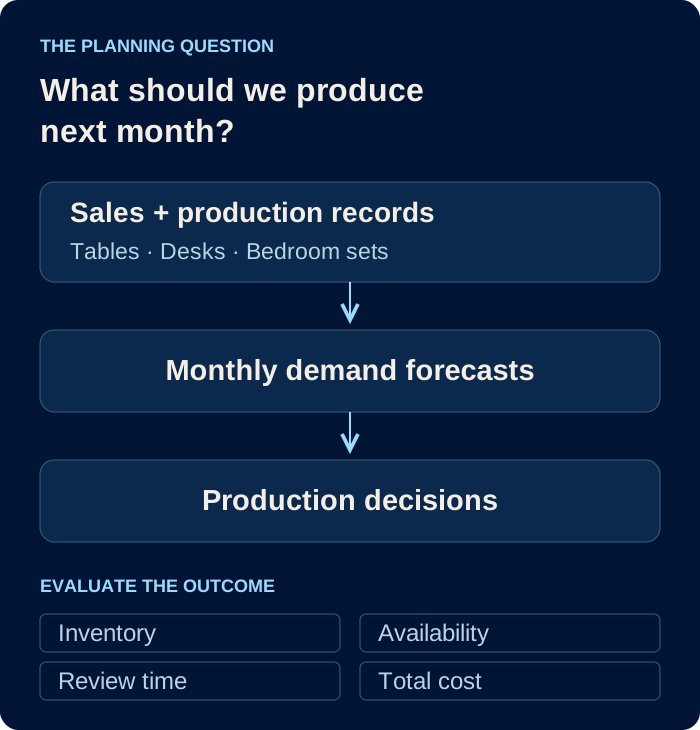
A furniture manufacturer needs to decide how many dining tables, office desks, and bedroom sets to produce each month.
Some products sell consistently. Others experience seasonal demand spikes or shifts in customer preferences. Produce too much, and unsold inventory takes up warehouse space and ties up capital. Produce too little, and the company risks delayed orders and missed sales.
After reviewing its production and sales records, the company finds that forecasts generated by its existing planning software frequently miss these demand variations, contributing to excess inventory and shortages. Adjustments to its forecasting process have not resolved the problem.
The manufacturer now needs more reliable forecasts. Should it purchase an existing forecasting solution or invest in custom AI development?
Both approaches could work. The question is which can deliver better results at a cost that makes business sense.
Set the baseline
Start With What the Business Needs
Before comparing solutions, the manufacturer needs to define what improvement would make the investment worthwhile.
For this scenario, suppose the company sets a goal of reducing excess inventory by 20% over the next six months, without increasing shortages or delayed orders. It also wants to spend less time manually reviewing and correcting forecasts.
To measure progress, the manufacturer would track:
- Excess inventory: Progress toward a 20% reduction from current levels.
- Product availability: No increase in shortages or unfilled orders.
- Planning efficiency: Less employee time spent correcting forecasts.
- Total cost: Savings relative to implementation and ongoing expenses.
The current forecasting process provides the baseline for evaluating both approaches. The 20% target helps guide the comparison, but the company should also consider whether a smaller improvement could deliver sufficient value at a lower cost.
Before testing either solution, the company must also confirm its data is reliable. For example, sales records that exclude unfilled orders can underestimate actual demand, regardless of the forecasting software used.
A third outcome
Keep what works.
Build what is missing.
An existing product can support established workflows while a focused custom component handles an unresolved forecasting requirement. Include integration and ongoing support in the comparison.
Evidence / A separate, reported project
A Similar Challenge We Addressed
In our forecasting project with an ice cream manufacturer, different demand patterns across 72 flavors made a single forecasting approach less effective.
Rather than applying one model to every flavor, we evaluated five machine learning architectures for each product, tested them against historical production and sales records, and selected the best-performing approach. The resulting solution was delivered through a production-ready forecasting API.
These are outcomes reported in the published Software Sushi case study. The published account does not include the baseline dataset or measurement methodology.
These results show what a tailored forecasting approach can achieve when different products require different forecasting methods. They do not establish that custom development always outperforms commercial software, but they demonstrate the value of addressing specific forecasting limitations.
For manufacturers with similar requirements, custom machine learning development can help address forecasting challenges that existing products cannot adequately support.

03 / Make the decision
Compare the Results, Not Just the Features
For the furniture manufacturer, the decision comes down to which approach delivers the greatest business value relative to its total cost.
Both solutions should be evaluated against the same criteria:
| Business Objective | What to Evaluate |
|---|---|
| Reduce excess inventory | How much progress does each solution make toward the 20% reduction target? |
| Avoid additional shortages | Does improved forecasting maintain or improve product availability? |
| Reduce manual planning | How much employee time is still spent reviewing and correcting forecasts? |
| Justify the investment | Do the savings outweigh implementation, integration, and ongoing operating costs? |
Suppose the commercial product delivers a meaningful reduction in excess inventory but does not fully reach the 20% goal. Custom development may be worthwhile if testing shows that it can deliver enough additional savings to justify the investment.
However, if the commercial product delivers nearly the same business value at a substantially lower total cost, building a custom solution would be difficult to justify.
The manufacturer must also consider the effort required to put either solution into operation. A subscription may involve configuration, training, and integrations, while custom software requires development, deployment, maintenance, and technical support.
Frequently asked questions
Does a forecasting problem require custom AI?
No. Test a configured commercial product against your current process first. Custom development is worth evaluating when important requirements remain unmet and the potential value justifies the cost.
Is better forecast accuracy enough to choose a solution?
No. Compare inventory, shortages, manual review, and total cost too. The useful result is a better planning process, not only a better model score.
Can we combine an existing product with a custom component?
Yes. A focused forecasting component can address an unresolved requirement while the existing product continues to support established workflows. Include the integration and support effort in the comparison.
Before You Decide to Buy or Build
The manufacturer's forecasting problem does not automatically require custom AI.
If a commercial product delivers meaningful improvements at an acceptable cost, buying may be the right decision. If important forecasting limitations remain and a custom approach demonstrates enough additional value, development may be justified.
The company may also find that combining both approaches makes sense, using existing software for established processes while developing capabilities for specific requirements.
Build when the additional business value justifies the investment, not simply because a custom solution is possible.
At Software Sushi, our AI & ML consulting services help businesses evaluate existing technology, identify unmet requirements, and determine where custom development can deliver meaningful value.
Book a discovery call to explore the right approach for your business.