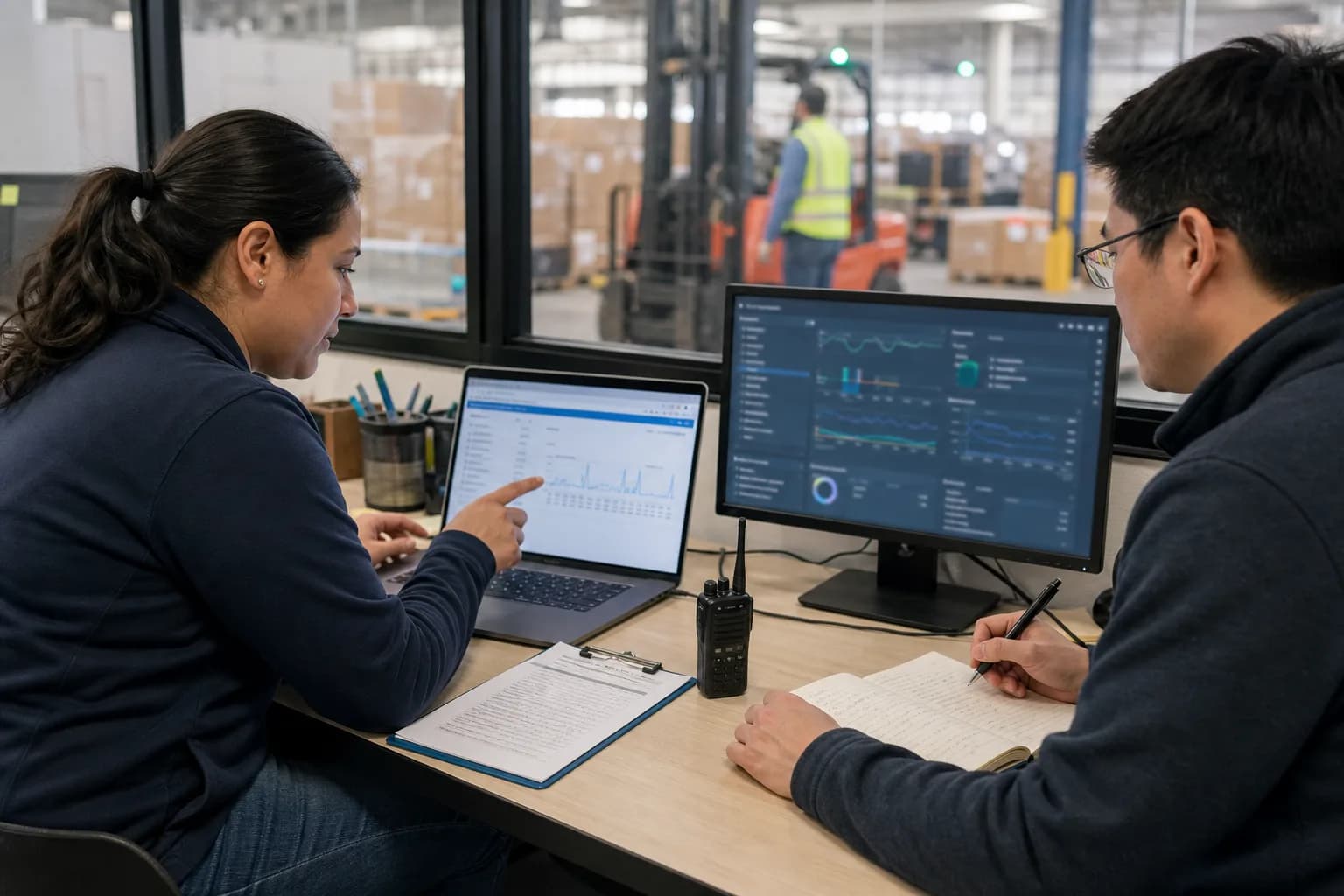
Production Readiness Assessment
A structured review of the pilot, its data, its success metric, and its operating context, with a prioritized plan and a go, rework, or stop recommendation.


We find out why a pilot stalled, then engineer the data pipelines, integrations, evaluation, and monitoring it needs to run inside real operations - with clear ownership after launch.
Most AI pilots do not stall because the model is weak. They stall because the pilot ran on curated data, lived outside the workflow it was meant to change, had no owner after the demo, and never defined the business result it was supposed to move.
Getting to production means closing those gaps deliberately: reliable data, integration with the systems people already use, evaluation that reflects real inputs, and monitoring that catches problems before users do. We engineer that path as one system instead of patching the pilot one issue at a time.

Every engagement starts by reviewing the pilot itself: the code, the data it was trained and tested on, the success metric, the workflow it was meant to support, and who owns it today. The outcome is a clear recommendation to harden what works, rebuild what does not, or stop before more budget is spent.
Each workstream is scoped from the readiness assessment, so the engagement covers the gaps your pilot actually has rather than a generic checklist.
A structured review of the pilot, its data, its success metric, and its operating context, with a prioritized plan and a go, rework, or stop recommendation.
Reproducible pipelines that replace one-off exports, with validation that flags missing, late, or out-of-range data before it reaches the model.
Connections to the CRMs, ERPs, internal tools, and databases your team already uses, so the system changes daily work instead of sitting beside it.
See how we approach AI integrationTask-specific test sets and acceptance criteria agreed before launch, so every model or prompt change is measured against the same bar.
How we evaluate RAG retrieval qualityDeployment pipelines, versioning, and alerts tied to model behavior and business outcomes, with clear retraining and review triggers.
Why ML models degrade after launchRight-sized serving, batching, quantization, and caching so the system meets its latency target at a cost the business can sustain.
An ice cream manufacturer needed forecasts that reflected how each flavor actually sells. We built a dedicated model for each flavor, evaluated five architectures per flavor against historical production and sales data, and delivered the selected forecasts through a production-ready API.
Read the full case studyNot every pilot should go to production as it was built. Some need a narrower scope, some need better data before any more engineering, and some solved a problem the business no longer has.
We say so before the build. A clear stop decision is worth more than months spent hardening a system nobody will own or use.
The pilot works on representative data and fits the workflow; it needs production engineering.
The idea is sound but the data, scope, or architecture must change before it can be trusted.
The expected value does not justify the remaining effort, and the evidence shows why.
Review the pilot code, data, evaluation, workflow, and ownership, then agree on the business outcome production must deliver.
Learn how our consulting worksDefine the production architecture, acceptance criteria, rollout approach, and a fixed-scope estimate for the work the assessment uncovered.
Build the data pipelines, integrations, evaluation, security, and observability the pilot was missing, tested against real inputs.
Roll out in stages with the people who depend on the system, monitor quality and cost, and hand over clear runbooks and ownership.
The system is judged on the result it was meant to move, not on model accuracy alone.
Inputs are reliable, validated, and available on the schedule the workflow needs.
Someone owns the system after launch, with the visibility and runbooks to act on problems.
The system lives where the work happens, with human review at the points where errors are costly.
Clear answers on scope, architecture, data, and delivery.
Pilots are usually built to prove that a model can work, not that a system can keep working. The common gaps are curated data that does not match production inputs, no integration with the real workflow, no owner after the demo, and no agreed business outcome. Closing those gaps is engineering and operations work, not more model tuning.
Yes. We start with a readiness assessment of the existing code, data, and evaluation, then recommend whether to harden it, rework parts of it, or rebuild. Reusing what works is usually the fastest path.
It depends on the gaps the assessment finds: data pipelines, integrations, evaluation, and monitoring each add scope. We provide a fixed-scope estimate after the assessment rather than an open-ended retainer.
Access to the pilot code and representative data, a business owner who can define success, and time with the people whose workflow the system will change. Their feedback during testing is what makes the rollout stick.
If it is still unclear whether the approach can work on your data, yes. A focused proof of concept answers feasibility first. If a pilot already works on representative data, the next step is production engineering.
Yes. We stay involved after launch to monitor quality, latency, cost, and drift, and we document the system so your team can own it with confidence.
We right-size the serving infrastructure, batch and cache where the workload allows, apply quantization or smaller models when quality holds, and track cost per request alongside quality metrics.
Tell us what the pilot does, what data it uses, and what result the business expects. We will help you decide whether to harden it, rework it, or stop.