Object Detection and Counting
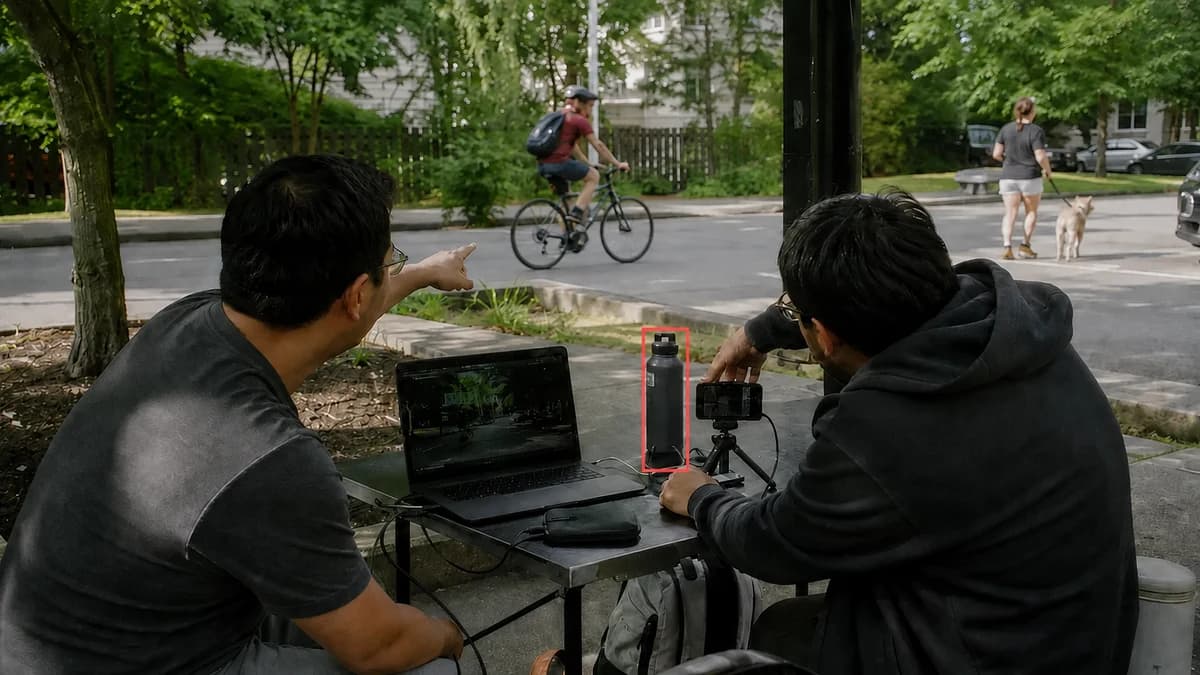
Custom detectors, such as YOLO models trained on your data, that locate, classify, and count objects in images or video streams.
Object detection using YOLO

We build custom computer vision, from data preparation and model training to deployment and monitoring, engineered for the lighting, cameras, and edge cases your operation actually has.
Vision models are sensitive to everything a demo hides: camera angle, lighting, motion blur, occlusion, and objects that look slightly different from the training set. A system that performs well on curated images can fail quietly the first week it sees real footage.
We engineer computer vision as a complete system: data collection and labeling, preprocessing, the right model for the job, evaluation on your own images or video, and deployment where the decision needs to happen.
We start with the decision the system must support and the conditions it will run in, then choose the simplest approach that can meet the accuracy and latency required.
Custom detectors, such as YOLO models trained on your data, that locate, classify, and count objects in images or video streams.
Object detection using YOLOSystems that flag defects, missing parts, or anomalies against clear thresholds, with uncertain cases routed for human review.
Separating objects from background to measure size, shape, area, or coverage, using classical techniques or trained segmentation models.
OpenCV filtering and segmentation guideReading text, labels, and forms from scans and photos, with preprocessing for skew, glare, and uneven lighting.
Frame-level detection and event logic that turns camera feeds into alerts and records, with privacy controls where people are on camera.
Optimized inference on cloud GPUs or edge devices, sized for the latency, connectivity, and cost constraints of each site.
We helped a correctional technology company bring an AI-powered safety monitoring platform to production, including AI and computer vision workflows, HIPAA-focused security and architecture work, and production engineering, testing, and deployment support for real-world correctional environments.
See the work we have deliveredNot every vision problem needs a neural network. With a fixed camera, controlled lighting, and consistent objects, classical techniques such as thresholding, contours, and template matching can be fast, explainable, and cheap to run.
When appearance varies widely, a trained model is usually more robust. Most production systems combine both: classical preprocessing and validation around a learned detector.
Best for controlled conditions, tight latency budgets, and problems where every decision must be explainable.
Best when objects, lighting, or backgrounds vary and enough labeled examples can be collected.
Review the decision to support, the cameras and conditions, existing images or video, and what accuracy and latency are required.
Build a focused proof of concept on your own footage to confirm the approach before investing in full data collection and labeling.
How our AI proof of concept service worksPrepare and label data, train and evaluate models against representative holdout sets, and integrate results into your workflow.
Deploy to cloud or edge, then track accuracy, latency, and drift as cameras, lighting, and objects change over time.
Accuracy is measured on footage from your environment, not on public benchmarks.
Lighting changes, occlusion, and rare events are collected and tested deliberately.
Uncertain detections are routed for review where an error carries real cost.
Where people are on camera, data handling and retention are designed in from the start.
Clear answers on scope, architecture, data, and delivery.
We build object detection and counting, visual inspection and defect detection, segmentation and measurement, OCR and document vision, and video analytics systems, deployed in the cloud or at the edge.
Both. Classical OpenCV techniques work well in controlled conditions and are fast and explainable. Deep learning models such as YOLO are more robust when appearance varies. Many systems combine the two.
It depends on how much the objects and conditions vary. We assess existing images or video first, and a focused proof of concept shows how much additional data and labeling the production system will need.
Yes. We optimize models for the latency, connectivity, and hardware constraints of each site and deploy to edge devices when sending video to the cloud is impractical.
Yes. We review the data, labels, evaluation, and deployment to find the limiting factor, whether that is training data, model choice, preprocessing, or how the results are used.
We design data handling, access, and retention around the use case from the start, and keep sensitive processing within infrastructure you control.
Share what the system needs to see, the conditions it runs in, and the decision it supports. We will help you choose the right approach.